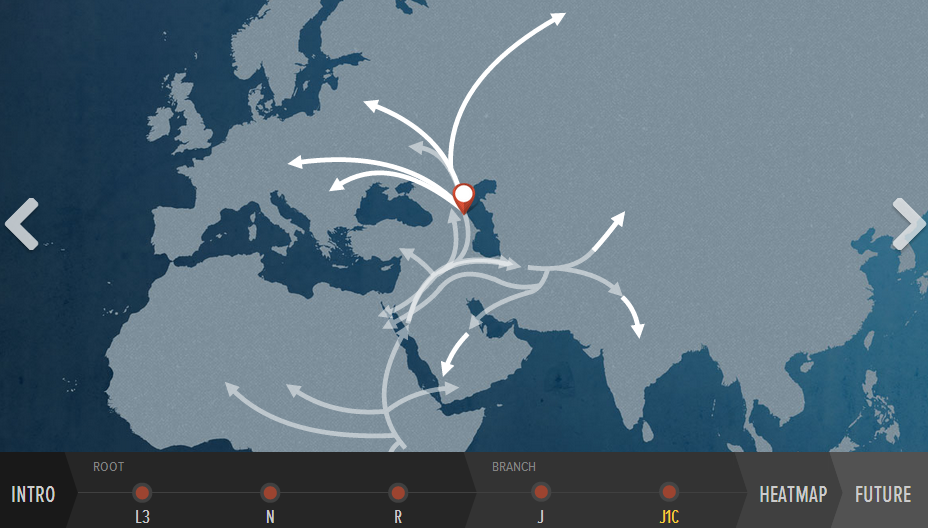
J-mtDNA - From National Genographic - No Longer Acrive

The common direct maternal ancestor to all women alive today was born in East Africa about 180,000 years ago. Though not the only woman alive at the time, hers is the only line to survive into current generations.

From East Africa, groups containing this lineage spread across Africa. Between 60 and 70 thousand years ago, some groups moved from Africa to Asia. Your line traces to one of these groups.

Around 32,000 years ago, your line was born in West Asia. There, your ancestors lived through the Paleolithic and the last glacial maximum. At the end of the last ice age, the beginning of settled agriculture triggered a population expansion among members of this line, but their story was just beginning.The map below shows how your female ancestors distributed around the world.


INTRODUCTION TO YOUR STORY

We will now take you back through the stories of your distant ancestors and show how the movements of their descendants gave rise to your lineage.

Each segment on the map above represents the migratory path of successive groups that eventually coalesced to form your branch of the tree. We start with the marker for your oldest ancestor, and walk forward to more recent times, showing at each step the line of your ancestors who lived up to that point.

What is a marker? Each of us carries DNA that is a combination of genes passed from both our mother and father, giving us traits that range from eye color and height to athleticism and disease susceptibility. As part of this process, the Y-chromosome is passed directly from father to son, unchanged, from generation to generation down a purely male line. Mitochondrial DNA, on the other hand, is passed from mothers to their children, but only their daughters pass it on to the next generation. It traces a purely maternal line.

The DNA is passed on unchanged, unless a mutation—a random, naturally occurring, usually harmless change—occurs. The mutation, known as a marker, acts as a beacon; it can be mapped through generations because it will be passed down for thousands of years.

When geneticists identify such a marker, they try to figure out when it first occurred, and in which geographic region of the world. Each marker is essentially the beginning of a new lineage on the family tree of the human race. Tracking the lineages provides a picture of how small tribes of modern humans in Africa tens of thousands of years ago diversified and spread to populate the world.

By looking at the markers you carry, we can trace your lineage, ancestor by ancestor, to reveal the path they traveled as they moved out of Africa. Our story begins with your earliest ancestor. Who were they, where did they live, and what is their story? The MtDNA shared by Beth and Serena and their descendants and ancestors on the female line are "J", called Jasmine. The MtDna is passed from mother to child with very minimal changes.


Human mtDNA Origin and Distribution


Human mtDNA Origin and distribution

The map illustrates the evolution and migration of individuals by mDNA. Our ancestors originated in Africa and slowly migrated around the world. Mutations in mtDNA occurred which were passed down to descendants. The table shows the estimated origin date of mtDNA mutations.

Family Tree DNA is a DNA testing company and has a great deal of interesting information on their site.

Click to view their page.

https://www.familytreedna.com/groups/j-mt-dna/about


 Haplogroup J was formed someplace in the Middle East and its branches are found primarily in the Mediterranean, Europe and western Asia today, plus, of course, diaspora regions like the Americas, Canada, Australia and New Zealand.

The mitochondrial Haplogroup J Project at Family Tree DNA provides a map of the most distant known ancestors of Haplogroup J members, including all branches, shown below.

My branch, haplogroup J1c2f, a rare haplogroup, is found in a much more restricted geography. It has taken 10 years or so to accumulate 10 pins on the map.  Of course, there would be more if everyone tested and joined their haplogroup project.

How Old is Haplogroup J?

With the mtFull Sequence test, you receive a lot more information than with the mtPlus test, for not a lot more investment, as you can see in the chart below and as we work through results.

HaplogroupBorn Years AgoReceive With Test
J34,000mtPlus
J127,000mtFull Sequence
J1c13.000mtFull Sequence
J1c210,000mtFull Sequence
J1c2f1,000mtFull Sequence


Click to Read Much More on this excellent site:


From Eupedia MtDNA J


The raphic above and text below are from Eupedia.com. There is some excellent information on the site.

https://www.eupedia.com/europe/Haplogroup_J_mtDNA.shtml


"Haplogroup J has been found in Bronze Age samples from the Yamna culture (J2b), Corded Ware culture (J1c and J2b1a), the Catacomb culture (J1b1a1), the Unetice culture (J1b1a1), and the Urnfield culture (J1b1), all in Central Europe. The Corded Ware culture is associated with the expansion of Y-haplogroup R1a from the northern Russian steppe, and in light of the continuity with Neolithic samples from Central Europe it can be assumed that J1c and J2b1a maternal lineages were not brought by the newcomers, but absorbed by the male invaders."

"On the other hand, J1b has never been found in Europe before the Bronze Age and was very probably brought by the Indo-Europeans carrying R1b paternal lineages. Both the Unetice and the Urnfield cultures are thought to have been founded mainly by R1b men. J1b has also been found among African tribes carrying R1b-V88 lineages, which would presume that J1b was one of the original maternal lineages found in R1b populations at least since the Early Neolithic (see R1b history). The absence of J1b in Bronze Age sites associated with the expansion of the R1a branches of the Indo-Europeans (Balto-Slavic and Indo-Iranian) supports that European J1b is exclusively associated with ancient R1b populationJ1b is also very common among non-R1b populations in the Middle East (notably the South Caucasus, Iran and the Arabian peninsula), although the subclades are different. The most common J1b subclade in Europe, and the one most strongly associated with Y-haplogroup R1b, is J1b1, and particularly J1b1a in Europe, which also happen to be the subclade identified in the Urnfield culture. Other subclades of J1b are restricted to the Middle East or the eastern Mediterranean."


The maps below were found by searching for J mtDNA. They show concentrations of JmtDNA. Higher concentrations indicate the likely location of our first JmtDNA ancestor.


The common direct maternal ancestor to all women alive today was born in East Africa about 180,000 years ago. Though not the only woman alive at the time, hers is the only line to survive into current generations.

From East Africa, groups containing this lineage spread across Africa. Between 60 and 70 thousand years ago, some groups moved from Africa to Asia. Your line traces to one of these groups.
Around 32,000 years ago, your line was born in West Asia. There, your ancestors lived through the Paleolithic and the last glacial maximum. At the end of the last ice age, the beginning of settled agriculture triggered a population expansion among members of this line, but their story was just beginning.

INTRODUCTION TO YOUR STORY

We will now take you back through the stories of your distant ancestors and show how the movements of their descendants gave rise to your lineage.
Each segment on the map above represents the migratory path of successive groups that eventually coalesced to form your branch of the tree. We start with the marker for your oldest ancestor, and walk forward to more recent times, showing at each step the line of your ancestors who lived up to that point.
What is a marker? Each of us carries DNA that is a combination of genes passed from both our mother and father, giving us traits that range from eye color and height to athleticism and disease susceptibility. As part of this process, the Y-chromosome is passed directly from father to son, unchanged, from generation to generation down a purely male line. Mitochondrial DNA, on the other hand, is passed from mothers to their children, but only their daughters pass it on to the next generation. It traces a purely maternal line.
The DNA is passed on unchanged, unless a mutation—a random, naturally occurring, usually harmless change—occurs. The mutation, known as a marker, acts as a beacon; it can be mapped through generations because it will be passed down for thousands of years.
When geneticists identify such a marker, they try to figure out when it first occurred, and in which geographic region of the world. Each marker is essentially the beginning of a new lineage on the family tree of the human race. Tracking the lineages provides a picture of how small tribes of modern humans in Africa tens of thousands of years ago diversified and spread to populate the world.


Migrations of Your Maternal Line 23 and Me

From 23andMe  https://www.23andme.comL


180,000 Years Ago

L3
65,000 Years Ago
N
59,000 Years Ago
R
57,000 Years Ago
J
34,000 Years Ago

Haplogroup L

 180,000 Years Ago

If every person living today could trace his or her maternal line back over thousands of generations, all of our lines would meet at a single woman who lived in eastern Africa between 150,000 and 200,000 years ago. Though she was one of perhaps thousands of women alive at the time, only the diverse branches of her haplogroup have survived to today. The story of your maternal line begins with her.

J1c3

9,000
Years Ago

Origin and Migrations of Haplogroup J1c3

Your maternal line stems from a branch of haplogroup J called J1c3. Haplogroup J1c3 is a relatively young branch of J that traces back to a woman who lived approximately 9,000 years ago. Her ancestors migrated into Europe from the Middle East as the Ice Age receded between 14,000 and 11,000 years ago. While J1c3 already existed in the west before the spread of agriculture, it likely expanded along with the farming populations as they moved west across the continent.

Today, J1c3 is found almost exclusively within Europe, and researchers speculate that the traces of J1c3 in the Middle East are due to eastward migrations of people much later in human history.

J1c3

Today

J1c3 is frequent among 23andMe customers.

Today, you share your haplogroup with all the maternal-line descendants of the common ancestor of J1c3, including other 23andMe customers.
1 in 100
23andMe customers share your haplogroup assignment.

Introduction

J mtDNA Migration - From National Genographic This blog is about Mitochondrial DNA Haplogroup J. Everyone has Mitochondria within their cell...